Strengthening Global Capacity to Sustain Transboundary Waters: The International Waters Learning Exchange and Resource Network (IW:LEARN), Operational Phase
The overall objective of this project is to improve the management of transboundary water systems by increasing the capacity to identify, disseminate and replicate best practices and lessons learned across the GEF IW projects. This objective will be achieved through a suite of learning exchanges, knowledge sharing activities, joint demonstration activities, and related capacity building Information Communication Technologies (ICT) activities among GEF supported IW projects and their partners. In view of the great interest raised by and successes of the experimental phase (implemented by UNDP), all three agencies have decided to jointly implement the the follow up project presently proposed.
GEF IW:LEARN consists of two projects, one UNDP- and one UNEP-implemented, which focus on strengthening transboundary water resources management (TWRM) by facilitating structured learning and information sharing among stakeholders of GEF IW projects. In pursuit of this global objective, IW:LEARN’s website provides easy access to relevant information and knowledge-sharing resources, and IW:LEARN also assists GEF IW projects in improving their information base, replication efficiency, transparency, stakeholder ownership and sustainability of benefits.
GEF IW:LEARN’s stakeholders include the GEF International Waters project portfolio, their partners and stakeholders as well as cooperative initiatives around shared water bodies that are not supported by the GEF. At local, regional and global scales, GEF IW stakeholders adapt and apply learning, information, skills and tools obtained through IW:LEARN and other means to advance and sustain ongoing project benefits in their respective transboundary waters regions.
UNDP serves as lead implementing agency for structured learning activities (with oversight provided by a World Bank Learning Coordinator), global stocktaking meetings, and stakeholder engagement activities in this GEF project. UNEP serves as lead Implementing Agency for the GEF IW information management system and services to GEF IW projects. These joint projects are implemented in close programmatic cooperation with the GEF International Waters Task Force, and are administered by a Steering Committee comprised of GEF IW leads from the GEF Secretariat, UNDP, UNEP and the World Bank. UNOPS serves as GEF IW:LEARN’s executing agency (EA).
Main activities of this phase of GEF IW:LEARN:
A.Facilitation of access to information on transboundary water resources among GEF IW projects
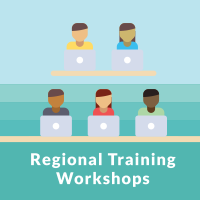
B.Structured learning among GEF IW projects and cooperating partners
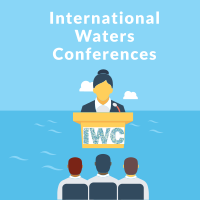
C.Biennial International Waters Conferences
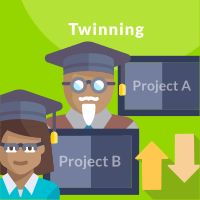
D.Testing innovative approaches to strengthen implementation of the IW portfolio E.Fostering partnerships to sustain benefits of IW:LEARN and associated technical support.
http://www.iwlearn.net
| TDA/SAP |
|---|
| No items found... |
| Documents & Resources |
|---|
 evaluation
 iwlearn_finalmte
 iwlearn_pirapr_2008-2
 IWC4 Participants
 Promoting GEF IW Knowledge Sharing and Public Involvement (Sklarew, Dann)
 GEF IWC4 Reflections Video
| General information | |
|---|---|
| GEF ID | 1893 |
| Project type | Full-Size Project |
| Status | closed (Project Closure) |
| Start Date | 20 Sep 2004 |
| End Date | 01 Oct 2009 |
| GEF characteristic: | |
|---|---|
| Focal Area | International Waters |
| GEF Allocation to project | USD 6,000,000 |
| Total Cost of the project: | USD 12,135,000 |
| Partners |
|---|
|
Global
United Nations Development Programme (UNDP) |
| Project contacts |
|---|
|
Richard Cooper
Project Manager
Mish Hamid
Stakeholder Engagement Officer / Former IW:LEARN Project Manager
Khristine Custodio Gudczinski
GEF IW:LEARN (and UNDP Ocean Innovation Challenge) Communications Specialist
Sean Khan
Programme Officer/Information Mgmt.
|