
Strengthening Global Capacity to Sustain Transboundary Waters: The International Waters Learning Exchange and Resource Network (IW:LEARN), Operational Phase
|
|
|
General Information:
|
|
Project
Type
|
Full Size Project
|
|
Project
Status
|
Project Closure
|
|
Start Date
|
2004/11/03
|
|
End Date
|
2009/10/31
|
| |
|
GEF characteristic:
|
|
Strategic Priority
|
IW2 - Expand Global Coverage with Capacity Building Foundational Work
|
|
Operational Programme
|
OP10 - Contaminant-Based Program
|
|
Focal Area
|
International Waters
|
|
GEF Allocation to project
|
6.35M
US$ |
|
Total Cost of the project:
|
12.48M
US$ |
| |
|
Partners:
|
|
Lead Implementing
Agency
|
United Nations Development Programme
|
|
Other
Implementing Agency
|
UNEP, IBRD
|
|
Executing
Agencies
|
UNOPS, UNEP/DEWA
|
|
Other
Partners
|
SEA START-RC
|
|
|
Project
Description:
|
|
The
overall objective of this project is to improve the management of
transboundary water systems by increasing the capacity to identify,
disseminate and replicate best practices and lessons learned across the
GEF IW projects. This objective will be achieved through a suite of
learning exchanges, knowledge sharing activities, joint demonstration
activities, and related capacity building Information Communication
Technologies (ICT) activities among GEF supported IW projects and their
partners.
In pursuit of its global objective, IW:LEARN will improve GEF IW
projects’ information base, replication efficiency, transparency,
stakeholder ownership and sustainability of benefits through:
A.Facilitation of access to information on transboundary water
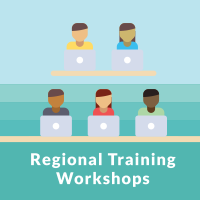
resources among GEF IW projects B.Structured learning among GEF IW
projects and cooperating partners
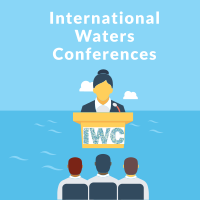
C.Biennial International Waters Conferences
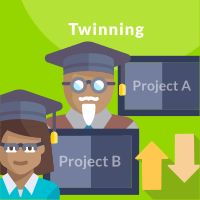
D.Testing innovative approaches to strengthen implementation of the IW
portfolio E.Fostering partnerships to sustain benefits of IW:LEARN and
associated technical support.
The present proposal clearly builds on the results achieved during the
experimental phase of IW LEARN, recently concluded, and incorporates
the findings of its final indipendent evaluation. In view of the great
interest raised by and successes of the experimental phase (implemented
by UNDP), all three agencies have decided to jointly implement the the
follow up project presently proposed.
|
|
|
|
|
|
|